27:11. Hint: you can enter both of the things I’m counting.
“In organic architecture, then, it is quite impossible to consider the building as one thing, it’s furnishings another, and it’s setting and environment still another.” –Frank Lloyd Wright
As we get ready to depart Wisconsin tomorrow, we are also leaving Frank Lloyd Wright’s home state and the area in which most of the FLW buildings we will see en route are located. Charles has already described most of these in previous postings. I just want to focus on a couple of things.
First, as Charles has mentioned, FLW was a major innovator in the field of architecture, being the first to design what we now call great rooms that combined kitchens with family and dining rooms, using under floor heating, track lighting, seamless window corners, and folding doors to open whole walls to the outside. He also invented the concept of car ports and, it can be argued, was the real father of ranch houses. The way he thought about his designs as being organic and part of the environment was truly unique. I could go on and on. But what really stood out from our visits of FLW homes was how far ahead he was of his architect cohort. His designs have much more in common with modern houses being built today, 70 or 80 years later, than they did with those of the day. FLW was truly a visionary. And so were his clients. They were individualists who valued what FLW had to offer and were willing to stand out in a crowd.
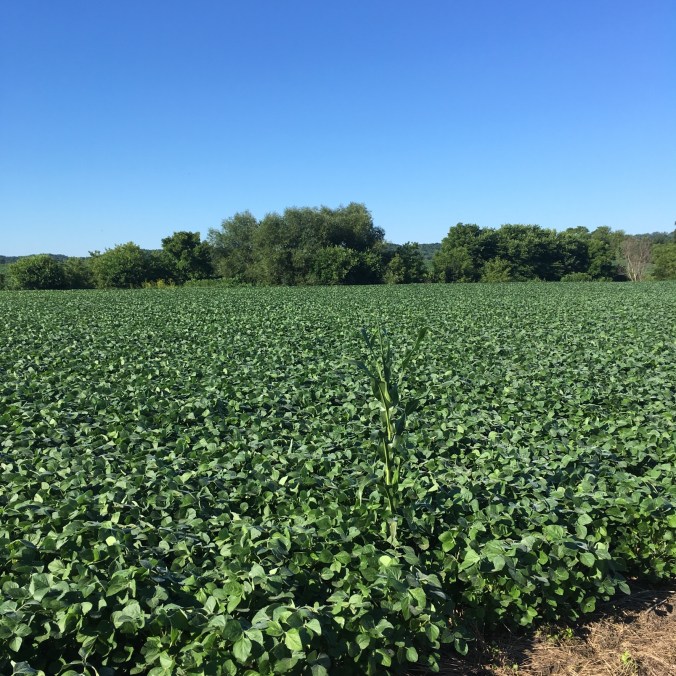
If you look closely enough, you will see one lone stalk of corn in a huge field of soy beans. The foot of the corn stalk is about an inch from the bottom of the photo and just right of center. I couldn’t help but think of the corn representing FLW, rising above his contemporaries.
We were lucky enough, on several occasions, to meet the owners or owner representatives of FLW houses that they had saved from almost certain destruction. Charles and I were so impressed with the passion that these owners brought to their homes, the precision with which they restored the structures, and their willingness to open the homes to the public. They, without exception, view what they are doing as a public service, both to the general public and their communities. We really couldn’t believe the “before” state to which some of these houses had fallen compared to the “after restoration” that we were viewing. In most cases, the restorations took years and costs hundreds of thousands of dollars over and above the purchase price for the house. In some cases, like for the Willey house, the new owners, using FLW’s original plans, finished several rooms that had never been completed by the original owners. We have so much to thank these individuals for and we look forward to keeping in touch with them.
 bikewright 2.0