The Willey House

Steve Sikora and Lynette Erickson-Sikora took on the challenge of restoring The Malcolm and Nancy Willey House (1934) in 2002. After the Willeys, the house had seen several owners and eventually sat derelict for several years exposed to the elements.  Parts of the house were never fully fleshed out even though Nancy Willey prevailed upon Wright to provide drawings for built ins and other cabinetry.  Steve and Lynette have done a prodigious amount of research on the house and have found drawings, period photographs, and letters between Wright and the Willeys in their effort to faithfully bring the house back to its original glory.

This house is the earliest expression of Wright’s Usonian ideas – open plan, L shaped around a garden terrace, simple materials, etc. and may be the inspiration for ranch houses of later years. It is Wright’s further exploration into redefining how the Amrican family lives. The clients represented a younger, middle class market that was different from Wright’s “typical” clients from his earlier Prairie style years who were older, wealthier and required larger homes. From the description that Steve gave us as he showed us the house, Nancy Willey was as influential in the design of the house as was Wright and wanted a house that was easy to maintain and that could work with them in the entertaining that was a part of their University of Minnesota life.

Originally, the odd shaped lot featured panoramic views of the Mississippi River and Wright oriented the house and developed the plan utilizing many diagonal aspects of the site’s relation to the river.

At every turn, from the reconstruction of the kitchen cabinets to the acquisition of period authentic appliances and furnishings and the craftsmanship of Stafford Norris,  the attention to the details throughout is impressive and inspiring.

Our few photos don’t do the restoration of the Willey House justice nor does my writing so I encourage you to go to the Willey House website for in depth information and beautiful photographs. www.thewilleyhouse.com.

Thank you Sterve for meeting us for the very informative tour on a Sunday morning and for all the work and TLC you and your family have put into this restoration.

image.jpeg


Another Fine Rest Day

We’ll get back on the road tomorrow I promise but we’ve needed these two days to recharge. First of all and most importantly, thanks to our friends Craig and Steve for putting us up, feeding us and allowing us to take a breather in their fabulous house. They helped us get our bikes to the One on One bike shop downtown for overhauls so our wheels are as good as new and ready to roll. Maja’s bike needed a new rear tire, the cables on both bikes needed tightening and both chains were replaced.  Thanks to Gene and crew for giving the Surlys the TLC they needed.  We feel confident they are up to the task of getting us to Bar Harbor.

This afternoon we reconnected with our friends Kip and Cindy we knew originally in Belgium – old home week – for a lunch full of old stories and laughter! This evening we’ll load up our panniers and make sure all is shipshape.

This morning Steve Sikora showed us the Willey House, an unforgettable experience of a meticulously restored and very important 1934 Wright house. I’ll write more about that in a separate blog.

Frank Lloyd Wright

As we’ve been biking and reading some of the historic markers along the roads, I’ve been thinking about how old Frank Lloyd Wright was during these events and how he might have thought about them as a child or young adult.  He was born on June 8, 1867 and we and lots of other organizations and institutions, including MOMA, will be celebrating his 150th birthday next year. It was fun to try to put myself in his shoes and imagine what I would have thought about some of the following events at his age. Newsworthy events included battles between Native Americans and US troops and the subsequent promises of reservations, discoveries of gold, the expansion of the railroad into and across western states and statehood.

We haven’t seen a lot of FLW designed structures so far, but hope to see the Willey House in Minneapolis next week and will be biking to Taliesin in Spring Green Wisconsin toward the middle of the month.  There’s no doubt that the times in which FLW was living influenced his thinking about buildings and architecture and I look forward to visiting his works with a new perspective gained from our ride.

WASHINGTON

  • Washington statehood in 1889.  FLW was 22 years old.  All in all, FLW witnessed the creation of 12 states during his lifetime, from Colorado to Alaska.  His death preceded Hawaii’s statehood by 4 months.
  • Klondike Gold Rush in 1897-99.  FLW was in his early 30s and was probably too well established by that time to be tempted.  But who knows?

IDAHO

  • Population. When FLW was 3, Idaho’s population was 18,999 and there was a mini gold rush going on.
  • 1870s.  Throughout the 1870s, when FLW was a boy, numerous Indian Reservations were established in Idaho and the railroad first entered the state, a momentous occasion in any of the western states’ histories.
  • Statehood.  Of the four states we’ve biked through to date, Idaho was the last to become a state in 1890.

MONTANA

  • Yellowstone.  In 1872, when FLW was just 5, Congress created Yellowstone National Park.
  • Chief Joseph and the Nez Perce Indians retreated across Montana in 1877 after their surrender at Bear’s Paw Mountain.
  • Railroad.  The railroad entered Montana in 1880.
  • Statehood.  On Nov. 8, 1889, Montana became the country’s 41st state.

NORTH DAKOTA

  • Custer’s last stand on June 25, 1876.  FLW would have just turned 9, an age when boys and girls were playing Cowboys and Indians when I was growing up.  At age 70 he was finding Native American petroglyphs at Taliesin West and giving them prominence in his new home in Scottsdale, Arizona.
  • Statehood in 1889.  North Dakota entered the Union as a State on Nov. 2, 1889 when FLW was 22.  In the intervening years the State had welcomed thousands of homesteaders and the railroad, which was a constant companion during our ride, entered the state.


Day 29 – New Salem to Bismarck

UPDATED

35 miles.

We got to Bismarck after going through our first rain of the entire trip! I got a hair cut!

our Warm Showers hosts, Ron and Joyce have been amazing and have kept us busy. Great meal and a tour of Bismarck including Fort Abraham Lincoln.

no wi fi so this will be short. Photos later.

on to Napoleon tomorrow.

We knew today would be short so slept in a bit  – we crossed into Central Daylight Time Zone (check out on a map where the dividing lines are between Mountain and Central zones and you’ll see they’re a bit crazy in North Dakota) and even though we reset our watches there was a glitch so the sleep-in was inadvertent. A little way outside of town we saw some nasty, dark clouds building up and could see the rain coming down to our left. We tried to outrun it but failed so had to stop and don our rain gear. The shower only lasted about 45 minutes and wasn’t  particularly heavy but we did get our shoes and heads wet. Then the sun came out for the rest of the day.

Ron and Joyce, our Warm Showers hosts, recommended that we stop at the North Dakota Heritage Center next to the State House. It is a great museum showcasing North Dakota history, dinosaur skeletons, a Native American wing and others. We learned, for instance that since the 2010 census, North Dakota is the fastest growing population state in the country. This is due in part to the workers associated with the Bakken Oil fields and that work has more or less stopped once the oil market collapsed. We also watched a fascinating video about chipping flint to make arrowheads.

Coming out of the center we were greeted by another line of dark clouds so beat a hasty path to Ron and Joyce’s house. They welcomed us in after taking our pictures for their album and fed us then drove us out to Fort Abraham Lincoln. This was the fort where Custer was stationed and from which he departed on his way to Little Big Horn. The fort sits high above the Missouri River and commands 360 degree views of the surrounding hills.  It is a little hard to imagine infantry and cavalry living there so far from the river and the city of Bismarck.

Ron also drove us to what is known in Bismarck as the Frank Lloyd Wright house. It certainly bears a Wrightian look from the prow to the fascia and the brick coursing but my web search of Wright houses says there are no buildings associated with Wright in North Dakota.  If anyone at Taliesin has an idea of the provenance of this house, let me know. You can tap on any of the photos to enlarge them to get a better view.

Tomorrow is a long day to Napoleon.


Day 12 – Eureka to Whitefish

56 miles today

Good start this morning after a restful night in the Silverado Hotel in Eureka. We back tracked our in-error route yesterday then at the end of town turned off the highway onto a small road that took us through forests … And no traffic.

image

After 17 miles or so this pleasant way dumped us back on the highway. It was Sunday so there was not too much traffic and no trucks but the shoulder was narrow.

We had lunch at the post office in Olney and hopped back on the road for the final 20 miles. Sadly, at that point the condition of Route 93 deteriorated badly making the biking very uncomfortable. It seems that everyone in Montana either drives a pick up or is towing some huge camper or trailer causing anxiety every time one passes us particularly if there happens to be oncoming traffic squeezing us all close together.image

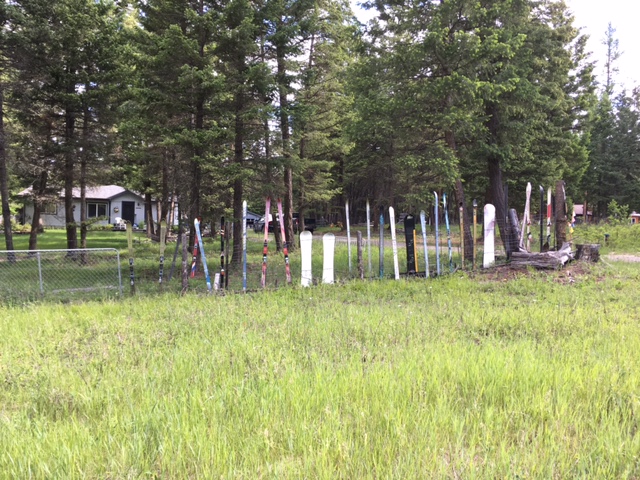
There are many crosses planted along the road, simple, small steel crosses painted white on 4′ posts. The speed limit on this rough road was 70 and we wondered if reducing the posted speeds might result in fewer crosses.

To make matters worse, the altitude profile we had seen for today’s ride failed to show several of the hills at the very end of our ride. These are the kinds of challenges that make me sigh and say “Really?”

We arrived mid afternoon in Whitefish and found our hosts. Turns out Rita, our host, knows Maja’s swim coach at Dartmouth.  Small world department.

image

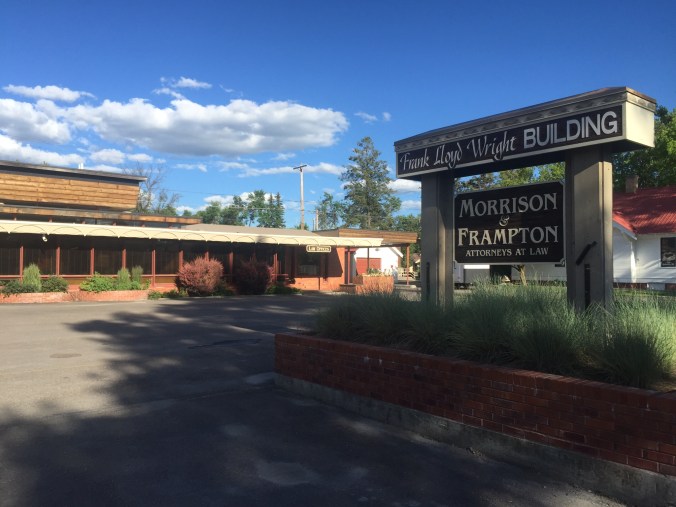
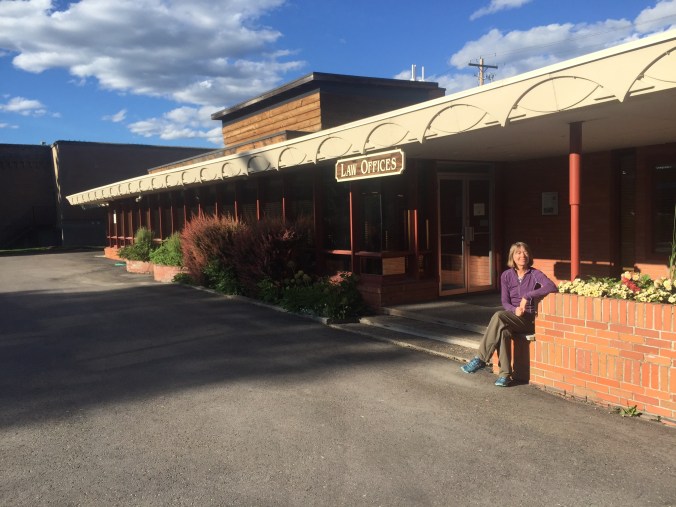
We visited our first Frank Lloyd Wright building of the trip, a small office building he designed for a friend of his in 1958. Wright died in ’59 so never saw the completed building. It has seen quite a bit of remodeling but is still known as “The Frank Lloyd Wright Building.”

image

Maja’s addendum:

As I look back at our rides, there appear to be two categories:  the “stop and smell the roses rides” and the “get from point A to point B” rides. Today was definitely the latter.  When we started the temps were in the mid 40s, so quite chilly. Luckily, it was partly sunny for the ride, so we warmed up. The ride on the two lane highway with the 70 mph speed limit was white knuckle most of the way. I’m sure the views were very beautiful, be we were totally focused on the road. We were happy to get to Whitefish! Our “warm shower hosts” are great and spoiled us with beer and snacks before we headed into town for dinner. There’s another cyclist staying here: an Aussie who is just about to finish the Mexico to Canada Continental Divide ride all on forest trails/roads. He averages about 100 miles a day. Wow! We also met a really interesting character in Eureka, who I think should be played by Johnny Depp, if there’s ever a movie made about him. He had a coonskin hat (tail and all), and approached us in the parking lot when he saw our bikes.  He had some interesting stories to tell about his architecture as well as fund raising experiences (said he raised $15 million). Very eccentric. We gave him our Bike Wright card.  So our string of meeting interesting people continues. That said, Montana gets demerits from a bike toting pick up driver who made fun of us in Eureka when we asked him for directions to the motel we wanted to stay at and he realized we had biked all the way through town, downhill, only to have to return the same way we came. He certainly takes the “Schadenfreude” award.  Looking forward to a short ride and some rest at Glacier!!!