Day 5 – Tonasket to Grand Forks, BC

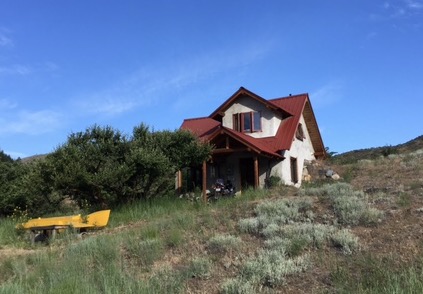
77 miles today in over 100 degree heat.  During our rodeo adventure last night we met Sarah and Walter who recommended an alternate route to the East that (1) avoided a lot of the intense climbing that awaited us and (2) took us through some very pretty high mountain pastures on very quiet roads. Competing with trucks and RVs on the highways (two lane state roads) is nerve racking and the noise annoying so the opportunity to get where we were going in more relaxed conditions was very appealing. Unfortunately, their route out of Tonasket started with 12 miles of Granny gear climbing so it wasn’t all a cakewalk.  The reward was breakfast at Sarah and Walter’s beautiful mountain home – 160 acres on top of a mountain that they handcrafted (Walter was a doctor and Sarah a Physician’s Assistant so it’s not like they had a lot of free time to build this house!) themselves while also raising their family. We took a long morning break and reluctantly got back on the road.

image

Breakfast view

The route was exactly as billed and after a pretty challenging climb, we began following another river so we had a fair amount of downhill for the rest of the day (with one painful exception). We stopped by a mountain lake and jumped in fully clothed just to cool off. We eventually joined the Kettle River road that follows that river downward. It actually flows north for a bit into Canada and will reemerge into the US on our trek tomorrow.

We had our passports but had to wait while they vetted us since we hadn’t been into Canada in over 22 years! But we made it in and are staying the night in a real hotel (no tent tonight).

Tomorrow will be a relatively short 88 km (we are in Canada remember) to a bike hostel in Colville, Washington, and we will rejoin our planned route and maps.

Day 4 – Omak to Tonasket

Only 26 miles today so more or less a “recovery” day.  For a change we didn’t have to head straight up the first thing in the morning. Breaking camp is getting more of a routine as is putting everything is the right pannier every day so one (meaning Charles) can always go straight to the first aid kit or the battery charger without emptying every dang bag!!!

We followed a river road through a Native American reservation with only a few ups and downs, and since the river is flowing in the direction we are headed, the grade is more or less down. The sandwich shop where we planned on having our breakfast at a town midway on today’s ride  was sold out of sandwiches since the owner had just passed away and the store was closing early but we have our trusty Cliff Bars!  Having enough water is a daily worry but with our on board bottles and our collapsible water bags I think we’re finally getting a handle on that.

We pulled into Tonasket right at the beginning of their annual Founders’ Day  parade – high school band, rodeo queens, Shriners on their motorcycimageles – just like the small town parades I grew up with in Missouri. They closed off Main Street and the sidewalks were lined with people … And here we thought they were there to welcome us to Tonasket!!

We made our way to the City Welcome Center that hosts bicyclists to camp right there on the main drag. We pulled up and there were ten or so people watching the parade from the front porch of the center so we joined in the group commentary and made quick friends with the folks that volunteer at the center.  Along with Founders’ Day was the annual rodeo. Linda, one of the volunteers, offered to pick us up and take us to the rodeo (well she said “1/2 a rodeo” was all she and her husband cold do and then head back into town for beers).

I’ll add more details when I have some more time and wi-fi but the short of it is that we had a great time and met more of Linda and Tom’s friends, drank some beers and climbed into our tent as music rang out from the bars in town. More later.

Day 3 – Twisp to Omak

37 miles. We awoke in our Warm Shower host’s house, treated him to breakfast and then headed out and up (again!). The road was up and up through forests devastated by the North Star fire a year ago -sad looking mountain sides of burned pines and charred ground cover.  So we climbed and climbed to the top of Loup Loup Pass that, coincidentally, is home to a new wolf pack.

Once at the top we oohed at the view and then descended to the town of  Omak and the city run campground where we tented in the middle of 30 or so RV’ers mostly from Canada, who complained about the “pitiful” state of the Canadian dollar. We can highly recommend the Breadline restaurant in Omak…HUGE portions and since we are burning many thousands of calories riding, we didn’t feel guilty at all about stuffing our faces including at the “well known” bread bar!!

Life in the RV park was a little strange with families living in tents side by side with the Canadians, stray dogs, late night phone calls with the woman tenting next to us at midnight, sun rising at 4:30 AM. But we’re surviving. Tomorrow is a relatively short day to the town of Tonasket and camping behind the city welcome center.

The photo at the top of this page I s representative of the gorgeous scenery we saw en route today.  The “no horses allowed” sign was in front of the rodeo next to which we camped.  Most small towns in Washington have their own rodeos of various sizes, but we hadn’t seen one before that didn’t allow horses.  Ha ha!

Maja’s Update

We arrived today in Tonasket, WA after a short (29 mile) ride. We were greeted by a Founder’s Day parade (we thought it was for us) which we watched from the porch of the visitor’s center, behind which we are tenting tonight–free for bicyclists. The people were incredibly nice and we are heading to the rodeo with some of them later this evening. Fun, fun! This is really a slice of Americana.

Our ride so far (with the exception of today) has been quite challenging. We started from Anacortes on Wednesday with a flat tire. Maybe that will be our only one :). I don’t know what possessed us to ride over 80 miles on the first day, given that our longest fully loaded ride before that was about 60 miles, and then follow that with another 80 miles the next day up the most challenging climb we’ll probably have, period. 42 miles uphill followed by an exhilarating descent. We arrived at our warm shower host’s abode totally exhausted at around 7:30 pm. There was really a time when we thought we wouldn’t make it, particularly as we ran out of water and there was nowhere to refill. I guess we learned our lesson! It was a long 12.5 hour day and our most challenging ride ever. But we made it! Along the way we enjoyed beautiful scenery, river beds that actually had water in them (!) as opposed to Arizona “rivers”, waterfalls galore, since it had poured the night before, and gorgeous wild flowers including wonderful wild lavender. Gorgeous! Our warm shower host was a minimalist. He designed and lives in a two room house, small living room, kitchen and dining table plus bathroom downstairs (about 200 square feet) and a bedroom upstairs, reached by a ladder. He rides his bicycle almost everywhere and when he’s low on time, he drives a moped. He rode his bike up the two very difficult passes we had just come over pulling a trailer weighed down by 150 pounds of stuff. And you think WE’RE crazy! In front of his house are the remains of a tri-maran he built himself. He’s a very nice guy and we had a wonderful breakfast with him before we set out on our second day of climbing.

Based on the trash we have seen along the side of the roads (you become quite aware of trash as you slowly cycle past), Washingtonians aren’t too bad when it comes to litter, but they do have a penchant for throwing out beer bottles and cans (mostly Budweiser), which makes up about 80 percent of the trash. Other bottles make up about 10% and the rest is miscellaneous, including such items as sofa cushions (oops), single shoes, a clamp (wonder what that was holding in place) and a badminton net.

People have been very nice and include many Canadians who holiday just south of the border because it’s a lot cheaper here. All are very interested in our ride and are encouraging.

After our first long day and then two days of climbing, we deserved a short rest day today. Tomorrow is another hard climb. We may decide to ride into Canada the day after tomorrow–a somewhat longer route, but it avoids some of the elevation of the US only ride. Decisions, decisions.

We have not had any political conversations, so far. And Washingtonians don’t seem very political, at least outwardly, since we have only seen two “Vote For” signs, and both were for Trump.

The weather has been varied and has included a night of pouring rain, with showers the next day, and now two sunny days of 97 degree heat. But still nothing compared to the 115 degrees all of you in Phoenix are suffering under. Lucky you.

Day 2 – Newhalem to Twisp

imageThe rain stopped early so we broke camp and headed out. The road starts up immediately eventually leading us from 600′ to just over 5000, the first test of our training! Up and up we slogged through waterfall vistas and valley views. There were occasional rewards of small downhill sections but the reality of the climb was a hard truth. We knew we had 40 miles to the top of Washington Pass but at the rate we (translate as “Charles”) was climbing, necessitating multiple stops for water and rest, the clock edged toward 6 hours in the saddle with no peak in view. Finally I succumbed to the effort and had to walk my bike. We agreed that Maja would go ahead and see accurately how many more miles we had while I sat disconsolate by the roadside! Poor, poor pitiful me. Almost immediately a very nice German couple stopped to ask if everything were fine … Of course not everything was fine and they took pity on my sapped strength and total lack of water (an early first lesson on this ride – always have more water than I think I will need. We loaded my bike and bags into the back of their pick up and Yvonne (of Andreas and Yvonne) offered me several bottles of water. We caught up with Maja and made the plan that I would be dropped off at Washington Pass and rejoin Maja on the road. Andreas and Yvonne dropped me off with more water and I was able to eat, drink and even cat nap for the interval it took Maja to catch up. When she arrived I was re-energized and we headed down, down, down to the valley and, eventually, Twisp.  So, my confession is that of the 4273 miles of our journey I did indeed cheat for 4 miles. There, the truth is out.

Eventually, and back in good form, we descended to Twisp and located the house of the Warm Showers host, Scott Demorgue. Trusting soul that he is, he had left his front door open and the futon ready so we gladly parked our bikes, showered and walked into Twisp to find food. We had arrived too late for the restaurant we wanted and another had a “closed” sign in the window but after we knocked, they agreed to stay open for us! One for our “kindness of strangers” files.

Scott’s house is a monument to simplicity: one room and bath on the ground floor and a loft where he sleeps. He’s been a Warm Shower host for a while and a long distance biker himself so understands the trials of the road. We enjoyed his company immensely and fell into deep sleeps on our return to his house. Tomorrow it’s over Loup-Loup Pass and into Omak.

So far we’ve totaled 85 plus 83 miles so the short 37 to Omak will be appreciated.


Day 1- Anacortes to Newhalem

day_1

I’m typing at the end of day three since our 4g has not been robust enough and there’s no wi-fi. We dipped our rear wheels in Pacific waters as the ritual demands and headed eastward. An inauspicious beginning, my rear tire was flat but Mike (our B&B host) quickly fired up his commercial compressor and we did enough to get rolling. Also typical of Day 1 uncertainties, we got off track several times so didn’t make blazing time. Our goal, as stated, was to make Newhalem (a hydro plant for Seattle Light) by 5 and we rolled in a little after 4 to the first drops of a drizzling rain. We gorged on junk food from the general store and pedaled back to our campground for the night. I’m sure we’ll get better at setting up the tent etc. but all things considered it went fairly smoothly. I fought with replacing my rear tire since it continued to slow leak all day requiring several stops to top it off. In the rain and besieged by mosquitos, I struggled and eventually wrestled the new tube into submission and Maja and I both settled in for a cold, rainy evening, raindrops percussing on our tent fly. Tomorrow our goal is Twisp but the challenge will be Rainy and Washington passes.

With a tip of the hat, let the games begin!

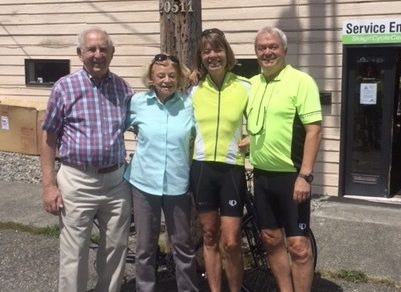
with_a_tip_of_the_hatHere we are on the eve of our grand adventure, staying at the Gateway Bed and Breakfast in Anacortes, WA. Thanks to Bernie and Joyce Zeldow for putting us up last night in Seattle and for driving us up here this morning.  Our bikes were reassembled and ready for us at the Skagit Cycle Shop and a shakedown mini-ride shows all systems ready to go.  Our first day is planned to to be 85 miles or so to Newhalem, WA, and the campground there. A full dinner tonight should get our engines ready to fly and we’ll head out early AM in hopes of making Newhalem before the sandwich shop there closes at 5. Weather forecast is clear and sunny so it’s off we go!

FAQs about our ride

faqs_about_our_ride

Why did we find riding across the country on bikes to be a challenge we wanted to adopt?

We had tossed around the idea of a long bike ride from the days when we lived in Europe and really enjoyed our week bike trip down the Loire Valley. Then after we moved back to the US this trip sounded epic enough!

Where will we stay?

We intend on camping most nights but will break that pattern occasionally for clean sheets, showers and laundry facilities at motels or hostels or Warm Showers hosts.  Also, have no worries, if it is dumping down rain with 40 mph winds, we will hunker down someplace comfortable and wait the storm out.

How long will this trip take?

We will start pedaling from Anacortes, Washington on June 1 and plan on being in Bar Harbor, Maine around the third week in August. We will get our rear tires wet in the Pacific and the front tires in the Atlantic.

How much pack are we taking?

Our bikes, Surly Disc Truckers, fully loaded with panniers front and back plus tent etc. weigh about 70lbs each. We may mail back home some things that we find are not necessary so the load could shrink a bit as we move East.

How far will we go daily?

We need to average about 50 miles per day to arrive in Maine by our planned date. We both feel that we can average more even with taking some rest days to see the sites along the way including Glacier National Park and the Frank Lloyd Wright buildings on our route.

How will we stay in touch?

We will each have our cell phones and iPads and will be updating this blog as often as we can.

What is our route?

We are not the first people to make this ride across America, and we will profit from the route knowledge of the American Cycling Association by purchasing their comprehensive maps and updates. We have transferred these maps into our Garmin GPS so we will have no excuses for getting lost.

How can you help?

You can support us by donating to help preserve Taliesin West. Learn more about Taliesin West here.

Why we are riding

why_we_are_riding

Bike Wright: Preservation Infrastructure Needs

Fred Prozzillo, Director of Preservation, The Frank Lloyd Wright Foundation

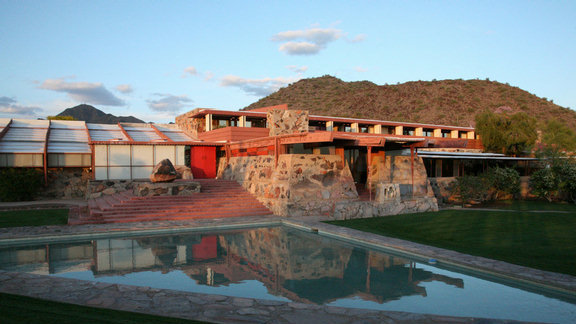
Taliesin West in Scottsdale, Arizona was the home, studio, and school of American architect Frank Lloyd Wright. Today, this National Historic Landmark is home to The Frank Lloyd Wright Foundation and The Frank Lloyd Wright School of Architecture. Recognized as one of Wright’s master works, it was his architectural laboratory where materials and architectural theories were tested as his apprentices constructed and re-constructed the buildings between 1938 and 1959, the year of Wright’s death. Today, we need your assistance in preserving this architectural gem.

In 2014 the Foundation developed a Preservation Master Plan to guide the future comprehensive restoration of this important architectural site. As part of the plan, a list of preservation priorities were outlined and recommended for completion before comprehensive restoration would take place. On this list were priority projects such as: monitoring and testing the concrete of the cabaret theater, stabilizing the roof of the original dining room, conserving a concrete slab with an inscription of a Whitman poem at the entrance to the property, and, developing a full scale mockup to test prototype fabric roofing systems that may someday be used in the restoration of the buildings of Taliesin West. But, of all the priorities listed, two stand out as critical to the success of future restoration efforts at Taliesin West: the plumbing and electrical infrastructure were listed as major projects that, if upgraded, would provide a sound foundation for future restoration efforts.

Taliesin West’s domestic water supply consists of galvanized pipe that is at the end of its service life. Installation of the lines started in 1939, after a private well was established on site.  Whereas the well system was recently updated, the domestic water lines are in varying states of failure. Repairs have been made over the last 50 years with copper, PVC, and Schedule 10 PVC (1970s). Additionally, the sewer lines and waste water treatment plant are in need of upgrading and now consist of varying materials: clay, concrete, cast iron, Orangeburg, ABS, PVC, and, they fail from deterioration. When repairs are needed, the loss of water results in the closing of the property, preventing the Foundation and the School from carrying out their mission.

To meet the demands of modern life, the electrical infrastructure at Taliesin West will also require significant upgrading. From the survey, a plan will be developed for future replacement and upgrade. The current infrastructure will not be sufficient to support the comprehensive restoration of the property, let alone the technology needed to succeed as a modern organization and school.

As the landscape surrounding the property is integral to the buildings, innovative solutions will be needed when undertaking the replacement of the infrastructure.  Our goal is to minimize the destruction of existing walkways and the surrounding desert, the desert that so struck and inspired Wright.  To assist us in this effort we assembled a team of engineers and contractors who are leading the field in horizontal boring and non-invasive construction. These leaders are eager to partner with us and carry out the work in a sensitive and non-destructive manner. As Taliesin West is a place of innovation and education, we plan to document this work and use it to inform the community about cutting edge technologies and advance new techniques in the construction industry.

Replacing the water, sewer, and electrical infrastructure at Taliesin West will be an important and delicate job.  Its replacement will insure this architectural masterpiece, and National Historic Landmark, will be around for generations to come.  With a sound infrastructure The Frank Lloyd Wright Foundation and The Frank Lloyd Wright School of Architect will be able to carry out their missions of educating the public, as well as future generations of architects, and inspire society through an understanding of Wright’s ideas and designs.  We hope you will support Bike Wright, so we may accomplish our goals and continue this important mission.

Visit FRANKLLOYDWRIGHT.ORG and click on “Bike Wright” to help support Taliesin West.

Tucson and other rides

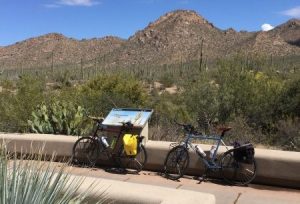
tuscon_and_other_ridesA week ago we drove to Tucson to visit some friends and managed two beautiful rides in the area, one on the east side of town toward Colossal Cave and the other to the west to the Sonoran Desert Museum and Saguaro National Park. We were not alone as Tucson bills itself as the “road biking capital of the US.”  Waving to many fellow bikers on both routes we saw one bike in particular that caught our eyes: a tandem with the front rider in a recumbent position!

Yesterday we biked 70 miles to the South here in Phoenix and the temperature on the roads was over 105′! Yes, it was hot and dry and we went through a lot of water. It is hoped that the temps on our ride will be less than what we found today.

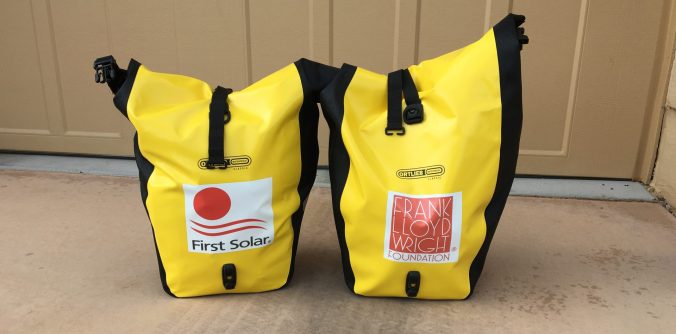
We’d like to thank everyone who has contributed to the Bike Wright initiative of the Frank Lloyd wright Foundation. Taliesin West is in need of serious infrastructure preservation and your donations will help a lot in conserving this American Masterpiece. We’d like to particularly thank First Solar for their generous support of this effort.