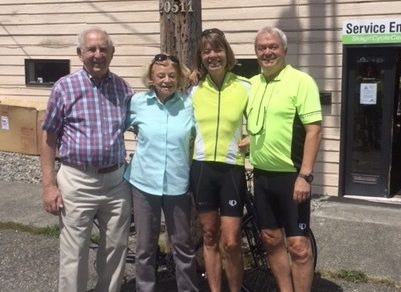
 Here we are on the eve of our grand adventure, staying at the Gateway Bed and Breakfast in Anacortes, WA. Thanks to Bernie and Joyce Zeldow for putting us up last night in Seattle and for driving us up here this morning. Our bikes were reassembled and ready for us at the Skagit Cycle Shop and a shakedown mini-ride shows all systems ready to go. Our first day is planned to to be 85 miles or so to Newhalem, WA, and the campground there. A full dinner tonight should get our engines ready to fly and we’ll head out early AM in hopes of making Newhalem before the sandwich shop there closes at 5. Weather forecast is clear and sunny so it’s off we go!
Getting ready
FAQs about our ride
Why did we find riding across the country on bikes to be a challenge we wanted to adopt?
We had tossed around the idea of a long bike ride from the days when we lived in Europe and really enjoyed our week bike trip down the Loire Valley. Then after we moved back to the US this trip sounded epic enough!
Where will we stay?
We intend on camping most nights but will break that pattern occasionally for clean sheets, showers and laundry facilities at motels or hostels or Warm Showers hosts. Also, have no worries, if it is dumping down rain with 40 mph winds, we will hunker down someplace comfortable and wait the storm out.
How long will this trip take?
We will start pedaling from Anacortes, Washington on June 1 and plan on being in Bar Harbor, Maine around the third week in August. We will get our rear tires wet in the Pacific and the front tires in the Atlantic.
How much pack are we taking?
Our bikes, Surly Disc Truckers, fully loaded with panniers front and back plus tent etc. weigh about 70lbs each. We may mail back home some things that we find are not necessary so the load could shrink a bit as we move East.
How far will we go daily?
We need to average about 50 miles per day to arrive in Maine by our planned date. We both feel that we can average more even with taking some rest days to see the sites along the way including Glacier National Park and the Frank Lloyd Wright buildings on our route.
How will we stay in touch?
We will each have our cell phones and iPads and will be updating this blog as often as we can.
What is our route?
We are not the first people to make this ride across America, and we will profit from the route knowledge of the American Cycling Association by purchasing their comprehensive maps and updates. We have transferred these maps into our Garmin GPS so we will have no excuses for getting lost.
How can you help?
You can support us by donating to help preserve Taliesin West. Learn more about Taliesin West here.
Why we are riding
Bike Wright: Preservation Infrastructure Needs
Fred Prozzillo, Director of Preservation, The Frank Lloyd Wright Foundation
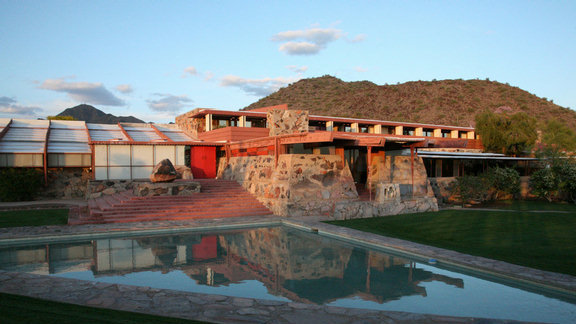
Taliesin West in Scottsdale, Arizona was the home, studio, and school of American architect Frank Lloyd Wright. Today, this National Historic Landmark is home to The Frank Lloyd Wright Foundation and The Frank Lloyd Wright School of Architecture. Recognized as one of Wright’s master works, it was his architectural laboratory where materials and architectural theories were tested as his apprentices constructed and re-constructed the buildings between 1938 and 1959, the year of Wright’s death. Today, we need your assistance in preserving this architectural gem.
In 2014 the Foundation developed a Preservation Master Plan to guide the future comprehensive restoration of this important architectural site. As part of the plan, a list of preservation priorities were outlined and recommended for completion before comprehensive restoration would take place. On this list were priority projects such as: monitoring and testing the concrete of the cabaret theater, stabilizing the roof of the original dining room, conserving a concrete slab with an inscription of a Whitman poem at the entrance to the property, and, developing a full scale mockup to test prototype fabric roofing systems that may someday be used in the restoration of the buildings of Taliesin West. But, of all the priorities listed, two stand out as critical to the success of future restoration efforts at Taliesin West: the plumbing and electrical infrastructure were listed as major projects that, if upgraded, would provide a sound foundation for future restoration efforts.
Taliesin West’s domestic water supply consists of galvanized pipe that is at the end of its service life. Installation of the lines started in 1939, after a private well was established on site. Whereas the well system was recently updated, the domestic water lines are in varying states of failure. Repairs have been made over the last 50 years with copper, PVC, and Schedule 10 PVC (1970s). Additionally, the sewer lines and waste water treatment plant are in need of upgrading and now consist of varying materials: clay, concrete, cast iron, Orangeburg, ABS, PVC, and, they fail from deterioration. When repairs are needed, the loss of water results in the closing of the property, preventing the Foundation and the School from carrying out their mission.
To meet the demands of modern life, the electrical infrastructure at Taliesin West will also require significant upgrading. From the survey, a plan will be developed for future replacement and upgrade. The current infrastructure will not be sufficient to support the comprehensive restoration of the property, let alone the technology needed to succeed as a modern organization and school.
As the landscape surrounding the property is integral to the buildings, innovative solutions will be needed when undertaking the replacement of the infrastructure. Our goal is to minimize the destruction of existing walkways and the surrounding desert, the desert that so struck and inspired Wright. To assist us in this effort we assembled a team of engineers and contractors who are leading the field in horizontal boring and non-invasive construction. These leaders are eager to partner with us and carry out the work in a sensitive and non-destructive manner. As Taliesin West is a place of innovation and education, we plan to document this work and use it to inform the community about cutting edge technologies and advance new techniques in the construction industry.
Replacing the water, sewer, and electrical infrastructure at Taliesin West will be an important and delicate job. Its replacement will insure this architectural masterpiece, and National Historic Landmark, will be around for generations to come. With a sound infrastructure The Frank Lloyd Wright Foundation and The Frank Lloyd Wright School of Architect will be able to carry out their missions of educating the public, as well as future generations of architects, and inspire society through an understanding of Wright’s ideas and designs. We hope you will support Bike Wright, so we may accomplish our goals and continue this important mission.
Visit FRANKLLOYDWRIGHT.ORG and click on “Bike Wright” to help support Taliesin West.
Tucson and other rides
 A week ago we drove to Tucson to visit some friends and managed two beautiful rides in the area, one on the east side of town toward Colossal Cave and the other to the west to the Sonoran Desert Museum and Saguaro National Park. We were not alone as Tucson bills itself as the “road biking capital of the US.” Waving to many fellow bikers on both routes we saw one bike in particular that caught our eyes: a tandem with the front rider in a recumbent position!
Yesterday we biked 70 miles to the South here in Phoenix and the temperature on the roads was over 105′! Yes, it was hot and dry and we went through a lot of water. It is hoped that the temps on our ride will be less than what we found today.
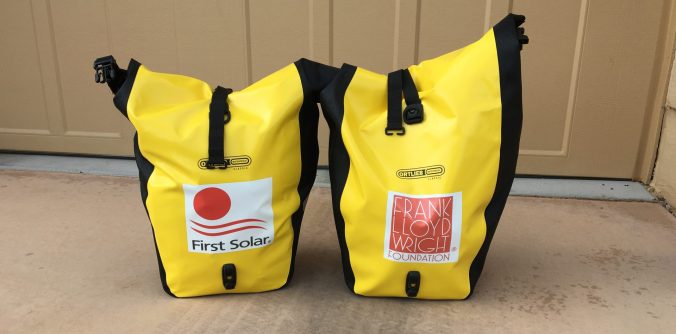
We’d like to thank everyone who has contributed to the Bike Wright initiative of the Frank Lloyd wright Foundation. Taliesin West is in need of serious infrastructure preservation and your donations will help a lot in conserving this American Masterpiece. We’d like to particularly thank First Solar for their generous support of this effort.
Plans are underway
We are working daily to finalize our plans for our across America bike trip. Training rides, diet, maps, bike accessories … these are the constants these days. We’d like to thank Vanessa at Landis Cyclery for her valuable help selecting and fitting our Surly Disc Truckers and Tom at REI, Scottsdale, for his tips and pointers. Of course none of this trip and fundraising would not happen without the help of Pamela Mundy, Dottie O’Carroll and Alison Rose at the Frank Lloyd Wright Foundation at Taliesin West. The conservation needs at this masterpiece of American architect Wright are great and we are hoping to raise enough money to help in the efforts to preserve and protect the buildings and site. Please help us raise money for this effort by logging onto the Frank Lloyd Wright Foundation website (www.franklloydwright.org) and click on the “Bikewright” tab to contribute. Every dollar you give will be matched so it’s a “twofer.”
 bikewright 2.0